-36x36.jpg)



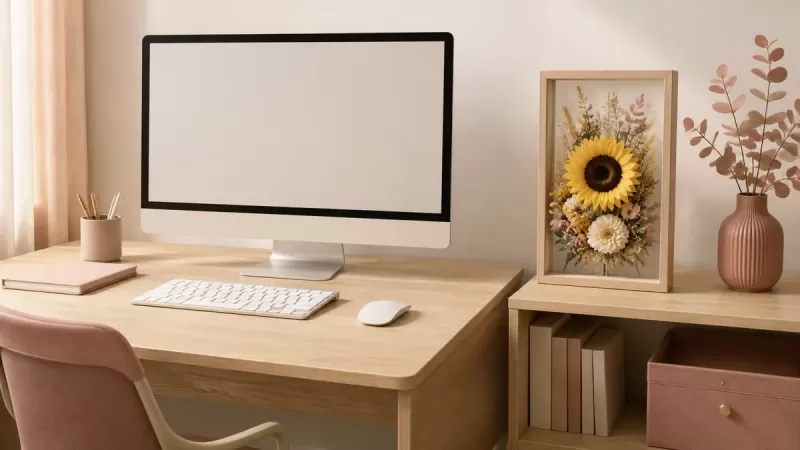
Preserved flowers can suit an office desk when they fit outside your working area, your workplace permits personal displays, and the location stays dry and out of direct sunlight. Choose the position before the arrangement: an attractive flower gift is not a good desk accessory if it displaces your mouse, blocks your screen or has to be moved every time you work.
This guide is a practical placement and buying checklist, not a claim that flowers improve productivity, purify office air or suit every shared workspace. The featured illustration shows a display-planning concept; it is not a photograph of a FLOWEROF product.
Start with permission and the way the desk is used
A permanent home-office desk and a shared hot desk need different decisions. Before buying for work, check whether personal objects may stay overnight, whether cleaning staff need the surface cleared, and whether you have an assigned shelf or locker. A small arrangement can still be unsuitable if the desk must be emptied every evening.
For a colleague, ask a simple question: “Would you enjoy a small flower display at work, or would you prefer something for home?” That prevents a gift from becoming an obligation to display it. Do not treat an open-plan desk as private space: consider nearby colleagues, the employer’s décor rules and any restrictions on botanical materials or fragrances.
Preserved does not mean certified fragrance-free, pollen-free or appropriate for someone with a particular sensitivity. If those properties matter, obtain product-specific information before ordering. An enclosure should not be treated as proof that a display meets a workplace restriction.
Measure usable space, not the whole desktop
Set up the items you actually use first: screen, keyboard, mouse, notebook, phone and any documents. Then identify a remaining area that does not change how you reach those items. Do this during an ordinary working session, not after clearing everything for a photograph.
The Oregon OSHA computer-workstation checklist checks that the keyboard and pointing device have adequate space, that the pointing device can be used without reaching, and that the monitor sits directly in front of the user. Our practical application is simple: decoration should fit around the working setup, not force the working setup around it. This is layout guidance, not an ergonomic assessment of your individual workstation.
- Measure the proposed display area’s width and depth.
- Check the arrangement’s complete outer dimensions, including its base or stand.
- Use a paper footprint and a lightweight height mock-up to check screen visibility.
- Test normal mouse movement, opening a notebook and reaching the phone.
- Choose a separate shelf if the display interrupts any of those actions.
A frame’s stated height and width do not necessarily tell you its standing depth. A rear support may need more space than the frame itself. Ask for that missing measurement instead of assuming that a slim-looking photograph proves it fits.
Match the display to your actual workstation
| Workspace | Useful starting point | Check before ordering |
|---|---|---|
| Small assigned desk | A compact framed composition beside the working area | Full standing depth, stability and screen clearance |
| Desk with a side shelf | A separate floral display visible from the chair | Shelf depth, secure support and room to lift the piece |
| Shared or hot desk | A home display, unless storage and daily movement are practical | Clear-desk policy and whether repeated transport is necessary |
| Sunny window desk | A shaded interior shelf away from direct sun | Where sunlight falls at different times of day |
There is no universal “best desk flower size.” A compact piece may work beside one monitor and obstruct another setup. If the only space is the narrow strip between the keyboard and desk edge, choose another location rather than squeezing the display into it.
A real FLOWEROF example, with the missing details made clear
The framed preserved sunflower art lists an approximate 20 × 15 cm size and two floral styles. It uses real dried and preserved sunflower heads behind a clear protective front. Those details make it a useful compact-format candidate to measure against your workspace, not a guarantee of desk compatibility.
Confirm standing depth, the intended support method and any mounting requirements before deciding between desk, shelf or wall placement. Do not assume wall fixings or a particular stand are included. Review the selected style in the live gallery; natural flower variation means the delivered botanical details need not be identical to a photograph.
If the sunflower palette does not suit the room, browse the preserved flower collection after measuring the available space. Larger rose displays may belong on a sideboard or shelf rather than beside the keyboard. Product dimensions and the actual use of the desk should decide this, not the appeal of the largest arrangement.
Check the light before committing to the position
Do not select a window ledge simply because it looks bright and attractive. Observe the proposed location in the morning and afternoon: a spot that is shaded during a video call may receive direct sun later.
Two independent conservation institutions support a cautious approach to light. The Canadian Conservation Institute’s plant-material guidance describes light-related weakening and color changes, including fading in applied colors. The American Museum of Natural History’s light-damage overview also identifies botanical and other organic collection materials as vulnerable to light damage.
These are conservation references, not tests of FLOWEROF arrangements. They support avoiding unnecessary direct light; they do not establish an exact retail-product lifespan or require an office to operate at museum lighting levels. Follow the instructions for the purchased product. For the sunflower frame, FLOWEROF specifies dry indoor display away from direct sunlight.
Plan cleaning and movement before adding decoration
Leave enough room to pick up the display by its supported base or frame without catching a cable. Do not balance it on a computer, printer or moving monitor arm. Keep it separate from the area where drinks are put down and where cleaning products are used.
Make one person responsible for moving it when the desk is cleaned. For the sunflower frame, use the specified dry, soft cloth on the outer frame and clear front; do not open the frame or handle the petals. Do not water or mist it. A preserved display is not a living desk plant that needs a colleague to water it while you are away.
If you choose a rose enclosure instead, follow the separate acrylic rose box care guide. Do not transfer cleaning methods between products without checking their instructions. An enclosure can still have vulnerable surfaces, and a routine office spray is not automatically suitable for it.
Repeated packing and unpacking is a practical disadvantage for a hot desk. If carrying the arrangement home is necessary each evening, a permanent home display may be the more convenient choice. The goal is a place you can use comfortably, not another fragile object to manage throughout the day.
Buying an office flower gift without creating extra work
For a welcome, promotion or thank-you gift, keep the message appropriate to the relationship. A short note explaining your appreciation is clearer than expecting a flower color to communicate it. Ask about the recipient’s space and style before choosing a personalized display they cannot easily relocate.
Check the building’s delivery arrangements and whether the recipient will be present. A reception desk, parcel room and individual workstation are not interchangeable delivery destinations. Use the current delivery information to check the ordering process, and confirm any unresolved timing or address details before payment. This guide does not promise arrival for a particular workday.
Need a dimension or support detail that is not listed? Ask FLOWEROF about the exact product with its name, the available width and depth, and whether you intend desk, shelf or wall placement. A specific question is more useful than asking whether something is simply “office suitable.”
Frequently asked questions
Can preserved flowers sit next to a computer monitor?
They can be considered for a separate, stable position if they do not obstruct the screen, controls, cables or equipment ventilation. Do not rest the display on the equipment. Check the manufacturer’s equipment clearances and the flower product’s care instructions.
Do office preserved flowers need sunlight or watering?
The FLOWEROF sunflower frame is intended for dry indoor display without watering, and its instructions say to avoid direct sunlight. Treat it as a botanical display, not a living plant. Check the specific instructions when selecting a different product.
What size is best for a small desk?
The best size is the one that fits the unused space after your working tools are positioned. Check width, height and standing depth together. A published two-dimensional frame size alone is not enough to establish its tabletop footprint.
Are preserved flowers suitable for every shared office?
No. Workplace rules, personal preferences and product-specific concerns still apply. Do not assume that preserved flowers are fragrance-free or that a clear enclosure satisfies a restriction. Ask before buying for a shared workspace.
Should I choose a desk or a separate shelf?
Choose the shelf when a desk display would interfere with normal work, but check that it offers stable support and is out of direct sunlight. Neither location is automatically suitable: the usable space and care conditions matter more than the label.
Will an office flower display last for a guaranteed number of years?
This guide makes no fixed-year guarantee. Product construction, care and display conditions differ. Judge the purchase by the verified product information and the place you can provide, rather than assuming an office or an enclosure ensures a particular lifespan.
Written and reviewed by FLOWEROF Editorial Team. Product details and sources checked 7 September 2026. Placement checklists are editorial recommendations; institutional conservation references are used only for the limited principles stated above.
Leave a comment