-36x36.jpg)


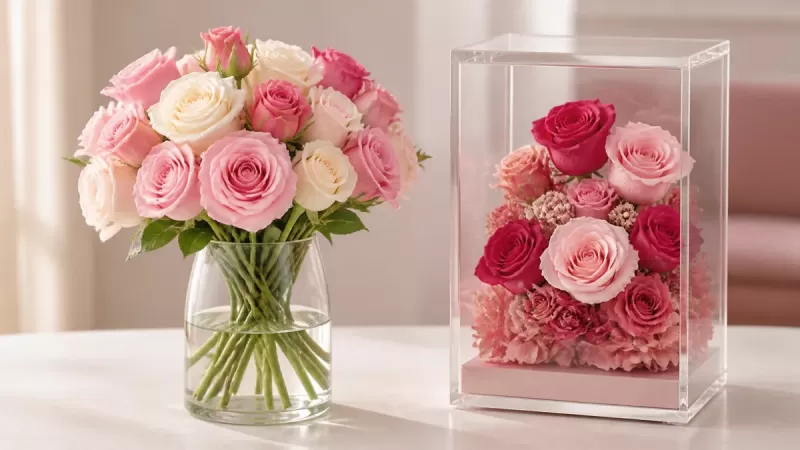
Choose fresh roses when the recipient values natural fragrance, changing blooms and the ritual of arranging flowers in water. Choose preserved roses when they prefer a finished dry display that does not need watering and can remain part of a room after the occasion. Neither format is automatically more romantic, more luxurious or more responsible. The better gift is the one that fits the recipient, the setting and the evidence you can verify.
This comparison focuses on practical differences rather than “forever” promises. It covers appearance, scent, care, timing, display, price evaluation and environmental claims, then turns those differences into a decision you can make before ordering.
Fact checked: 2 September 2026. Product options, stock, prices and policies can change. Review the live product page, Delivery Information and Terms & Conditions before purchase.
Quick comparison: preserved roses vs fresh roses
| Decision factor | Fresh roses | Preserved roses |
|---|---|---|
| Experience | Living cut stems that may open and change over time | Real botanical material treated and arranged as a stable dry display |
| Water | Needs a clean vase, water and ongoing care | Should not be watered or misted |
| Scent | Natural fragrance varies by rose variety and freshness | Do not assume the original scent remains or that fragrance is added |
| Display | Works as a temporary centerpiece or bouquet | Works as a longer-term indoor object when the format and space fit |
| Handling | Stems can be recut and rearranged | Petals and supports should be handled as little as possible |
| Best question | Will the recipient enjoy caring for changing flowers? | Will the recipient want a dry display in this specific size and style? |
Preserved roses are real botanical material, but they are no longer living flowers. Commercial preservation processes vary, so a retailer’s label does not prove one universal treatment, lifespan or ingredient list. Read how preserved flowers are made for the material distinction before comparing products.
1. Start with the experience the recipient actually wants
A fresh bouquet is an experience in motion: the recipient unwraps it, trims stems, chooses a vase, changes the water and watches the flowers open. That short-lived rhythm may be the point. Fresh roses can suit a dinner table, hospital visit, celebration or person who enjoys arranging flowers.
A preserved arrangement is closer to a decorative keepsake. Its shape and palette are selected in advance, and many FLOWEROF designs sit inside a frame or acrylic case. The recipient does not need a vase or watering routine, but they do need an appropriate indoor surface and must accept that the arrangement is meant to stay largely as delivered.
Do not infer preference from age, gender or social-media trends. Ask about the recipient’s home, habits and feelings about keeping objects. A compact apartment, frequent travel, pets, small children or a dislike of clutter can matter more than the flower label.
2. Appearance changes in different ways
Fresh roses can arrive tighter and open over several days. Their stems, leaves and petals vary naturally, and the bouquet may be rearranged. That movement and imperfection are part of a fresh-flower gift.
Preserved roses are chosen for a composed look. Dyeing or other preservation steps can create palettes that differ from fresh garden roses, while an acrylic enclosure adds visible reflections and edges. Evaluate the actual product photographs, complete dimensions, option labels and arrangement shape instead of expecting every screen color to match perfectly.
The Eternal Rose collection includes several display formats. A preserved rose swan creates a sculptural silhouette, while the colorful preserved rose heart and romantic pink or red rose heart use different palettes. Compare the photographed item rather than treating “preserved roses” as one uniform product.
3. Fresh roses need active vase care
Fresh cut roses depend on clean water and functioning stems. NC State Extension’s cut-flower guidance recommends clean containers, fresh angled cuts, removing leaves below the waterline, keeping flowers cool and changing water regularly. The exact vase life varies with freshness, variety, transport and care, so a single day count should not be treated as a promise for every bouquet.
Before sending fresh roses, check whether the recipient has a vase, can lift and change the water, and will be present to receive the flowers. A person may love fresh flowers but not the work that follows. If the answer is no, choose a simpler format or another gift rather than assuming care is trivial.
4. Preserved roses need restraint, not watering
Preserved roses are intended for dry indoor display. Do not water, mist or apply household sprays. Keep the arrangement away from direct sunlight, high moisture and strong heating or cooling airflow. Leave a protective cover in place and clean the outside rather than touching the petals.
Light exposure is cumulative for many colored organic materials. The Library of Congress guidance on limiting light damage explains that fading and color change can be irreversible and that sunlight is difficult to control. The American Museum of Natural History’s conservation guidance also explains why moderate, stable indoor conditions are preferable to extremes and rapid fluctuations.
These institutional sources discuss general preservation risks, not a guaranteed FLOWEROF product lifespan. Use the acrylic-box care guide for daily handling and the preserved-flower lifespan guide for the factors that can shorten or extend display condition.
5. Scent is a real preference, not a quality score
Fresh roses may provide natural fragrance, but strength varies by cultivar, freshness and individual perception. A preserved arrangement should not be purchased on the assumption that it will retain the original rose scent. Some products in the wider market may include added fragrance; FLOWEROF should state that only when it is documented for the exact item.
If scent matters, ask before purchase. If the recipient has sensitivities, do not label either format “hypoallergenic” or “safe” without product-specific evidence. A low-scent preference is not the same as a medical allergy claim.
6. Compare space, size and protection before style
A fresh bouquet needs vase footprint, water clearance and space away from electronics or unstable edges. A preserved arrangement needs a dry, level surface and enough room for the full enclosure, not just the flowers visible inside it. Measure the shelf, desk or table and compare that measurement with the live product dimensions.
An acrylic case can reduce routine dust and touching, but it does not make an arrangement unbreakable, airtight or maintenance-free. It also changes how the piece looks from different angles. Our evidence-led preserved rose selection guide shows how to check dimensions, material statements, color options and policies before relying on words such as “best” or “luxury.”
7. Evaluate price without inventing a universal winner
Price alone cannot tell you whether fresh or preserved roses are “worth it.” Fresh roses may include local florist labor, seasonal supply and delivery. A preserved arrangement may include treatment, structural design, an enclosure and more complex shipping. The relevant prices and inclusions vary by seller and date.
Compare the exact delivered price, documented dimensions, materials, care burden, policy and the recipient’s likely use. Avoid multiplying an advertised lifespan into a “cost per day” unless that lifespan is supported for the exact product and the display conditions are realistic. A gift that the recipient does not want has poor value regardless of how long it could remain on a shelf.
8. Do not decide the environmental question from one attribute
Neither “fresh” nor “long-lasting” proves lower environmental impact. Relevant factors can include cultivation, energy, water, preservation inputs, refrigeration, packaging, freight, replacement frequency and disposal. The balance changes with origin, product design, transport and how long the recipient actually uses the item.
The FTC Green Guides explain that environmental claims can mislead when consumers interpret them more broadly than the evidence supports. FLOWEROF should not call preserved roses eco-friendly, sustainable or lower-carbon without competent product-specific substantiation. Buyers should be equally cautious when a fresh-flower seller makes an unsupported “local” or “green” claim.
9. Match the format to timing and delivery risk
Fresh roses are time-sensitive and should be coordinated around receipt and vase care. Preserved arrangements remove the water requirement but remain delicate physical objects. Either format can fail as a surprise gift if the address is incomplete, the recipient is away or the parcel sits in unsuitable conditions.
For a preserved arrangement, allow separate production and transit time, verify the full address and ask someone to inspect the parcel promptly. Our preserved-flower delivery guide provides a complete receiving and damage-evidence checklist. A published estimate is not a guaranteed arrival date, so contact FLOWEROF before ordering when timing is critical.
10. Use this five-minute decision worksheet
| Question | Fresh roses may fit when… | Preserved roses may fit when… |
|---|---|---|
| What does the recipient enjoy? | Fragrance, changing blooms and arranging stems | A finished decorative object with minimal handling |
| What care is realistic? | Vase, clean water, recutting and regular water changes | No watering; dry indoor placement and gentle exterior dusting |
| Where will it go? | A safe vase location away from heat and drafts | A measured shelf, desk or table away from sun and moisture |
| What evidence is available? | Freshness, stem condition, variety and delivery timing | Actual photos, dimensions, option names, materials, care and policy |
| What would disappoint them? | Short duration or ongoing vase work | No natural flower-opening ritual, uncertain scent or a fixed display format |
If the answers are mixed, the format is not obvious—and that is useful. Choose the preference that matters most or ask the recipient. For preserved designs, browse the Preserved Flowers collection only after measuring the display area and reading the live specifications.
11. Evidence checklist before buying preserved roses
- Is the exact arrangement shown from enough angles to understand its shape and enclosure?
- Are complete dimensions stated, and will the display fit the intended location?
- Do option names map clearly to the photographs?
- Does the page distinguish real preserved botanical material from artificial flowers?
- Are care instructions specific and free from watering advice?
- Are lifespan, scent, material, safety and environmental statements qualified rather than guaranteed?
- Are production, transit, damage-reporting and return terms available before payment?
- Is support reachable if the product arrives damaged or different from the selected option?
Frequently asked questions
Are preserved roses better than fresh roses?
Not universally. Preserved roses suit a recipient who wants a finished dry display without watering. Fresh roses suit someone who values natural fragrance, changing blooms and the ritual of vase care. Match the format to the recipient rather than treating duration as the only measure.
Are preserved roses still real flowers?
Yes, genuine preserved roses begin as real botanical material, but they have been treated and are no longer living. Preservation methods vary, and the label alone does not prove one specific process or ingredient list.
Do preserved roses smell like fresh roses?
Do not assume they retain the natural scent of fresh roses. Fragrance can vary, and any added scent should be disclosed for the exact product. Ask the seller if scent is important to the recipient.
Do preserved roses need water?
No. Water and mist can damage preserved flowers. Keep them dry, indoors and away from direct sunlight, high humidity and strong heating or cooling airflow.
Are preserved roses more eco-friendly than fresh roses?
That cannot be concluded from “preserved” or “fresh” alone. A responsible comparison needs evidence about cultivation, processing, energy, packaging, freight, use duration and disposal for the specific products being compared.
What should I check before ordering an eternal rose gift?
Check real product photographs, full dimensions, palette labels, enclosure, care, production and transit estimates, damage reporting and return terms. Confirm critical timing in writing and avoid relying on unsupported “forever,” “safe” or environmental claims.
Reviewed by the FLOWEROF Editorial Team. This article compares gift formats and does not guarantee lifespan, fragrance, delivery timing, safety or environmental performance.
Leave a comment