-36x36.jpg)


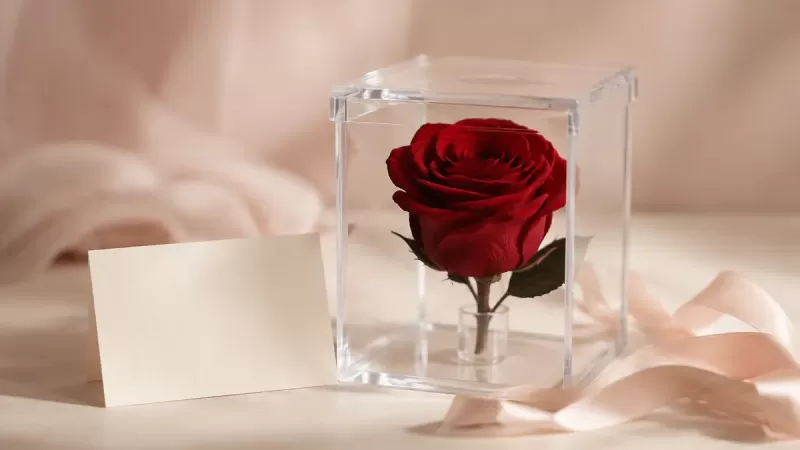
An eternal rose usually communicates that a feeling, relationship or memory is meant to be remembered beyond one day. The rose contributes a familiar association with love or appreciation, while the preserved display adds the idea of continuity. But the message is not universal: color, relationship, occasion and the words on the card determine what the recipient is most likely to understand.
That distinction matters. A red rose sent to a partner can feel openly romantic. A white or multicolor arrangement with a clear thank-you note may suit a friend, parent or colleague. The safest approach is to choose a rose that fits the person and explain your intention instead of relying on an internet color chart to speak for you.
Fact checked: 3 September 2026. Flower symbolism changes across cultures and over time. Product options, prices, stock and policies can also change; confirm the live product and policy pages before ordering.
Quick answer: what does an eternal rose symbolize?
| Part of the gift | Possible message | What to verify |
|---|---|---|
| Rose | Love, affection, beauty, appreciation or remembrance | The recipient's own associations and cultural context |
| Preserved format | A moment or feeling worth keeping | That the item is real preserved botanical material rather than soap, fabric, plastic or metal |
| Color | A tone such as romance, gratitude, friendship, calm or dramatic style | The exact palette shown on the product page; color meanings are not fixed rules |
| Display shape | A heart may read as more romantic; a swan, bouquet or frame can feel decorative or commemorative | Dimensions, photographs, enclosure and available options |
| Gift note | The sender's actual intention | Use plain words when the relationship could otherwise be misunderstood |
The Smithsonian Gardens overview of the language of flowers explains that floral meanings became especially popular in the nineteenth century and also warns that meanings and traditions change with time and culture. That is why this guide treats symbolism as a useful conversation aid, not a universal code.
1. The word “eternal” adds a keepsake idea, not a literal promise
In gift language, “eternal” commonly suggests continuity: an enduring relationship, a memory that still matters or gratitude the sender does not want to feel temporary. The physical object reinforces that idea because a preserved rose is arranged for dry indoor display rather than for a short vase cycle.
It is still important to separate metaphor from product fact. “Eternal,” “eternity” and “forever” are widely used retail labels; none guarantees a particular process, material or lifespan. Read the difference between eternal, eternity and forever roses before assuming one label proves quality. If you want to know whether the flowers are real, use the evidence-led guide to how preserved flowers are made.
A responsible message is therefore “I wanted you to have something that keeps this moment visible,” not “this will last forever.” The first describes your intention. The second makes a product-performance promise that may not be supported.
2. Rose symbolism is old, varied and culturally shaped
Roses have carried many meanings long before modern preserved-flower products. The University of Illinois Extension history of roses describes associations with love, beauty, war and politics. The Cornell University Library exhibition on floriography shows how people used flowers to communicate feelings, while also placing those meanings in a particular historical tradition.
This history gives a rose emotional weight, but it does not mean every recipient reads it the same way. Personal experience can override convention. Someone may connect red roses with an anniversary, yellow roses with a grandparent's garden, white flowers with a wedding, or black styling with a favorite interior rather than with a symbolic dictionary.
Use common associations as a starting point, then prioritize the recipient's preferences. A gift becomes more thoughtful when it reflects something you know about the person, not when it follows the largest number of online rules.
3. Is an eternal rose always romantic?
No. Roses are strongly associated with romance in many contexts, but an eternal rose can also express thanks, friendship, family affection, celebration or remembrance. The relationship, palette, shape and note work together.
Public gift discussions repeatedly show the same uncertainty: people ask whether a preserved rose is “too romantic” for a friend, which color feels platonic, and whether a dramatic black or multicolor arrangement changes the message. Those discussions are useful evidence of buyer confusion, not proof that one color has a fixed meaning.
If the recipient might reasonably interpret the gesture as romantic, do not make them decode it. Write a direct note such as “Thank you for being there for me” or “I chose these colors because they suit your room.” Clarity is kinder than asking the product to carry the whole message.
4. How color changes the tone of the gift
Color can steer the first impression, but it should not replace context. A Philadelphia Museum of Art exhibition on still-life symbolism describes familiar associations for red, white and pink roses, while Smithsonian Gardens emphasizes that floral meanings change. FLOWEROF's preserved rose color guide therefore presents associations as prompts rather than promises.
| Palette | Common contemporary tone | Useful caution |
|---|---|---|
| Red | Romantic love, passion or an important anniversary | Often reads as romantic unless your note makes another intention clear |
| Pink | Affection, admiration or gratitude | Can still feel romantic depending on the relationship and display shape |
| White | Calm, simplicity, sincerity or remembrance | Meanings vary widely across celebrations, weddings and memorial contexts |
| Yellow | Friendship, warmth or joy | Check personal and cultural associations rather than assuming one global meaning |
| Lavender or purple | Imagination, elegance or a distinctive visual style | Modern retail interpretations vary and are not historical facts |
| Black, rainbow or mixed | Dramatic, playful, artistic or room-led styling | Choose for the recipient's taste; do not assign a universal emotional message |
5. Match the message to the relationship
For a partner: a red or pink heart-shaped arrangement may reinforce romance, but the occasion and note should still feel personal. Mention the shared memory or quality you appreciate instead of writing an unsupported “forever” claim.
For a friend: choose colors they actually like and avoid an overtly romantic shape if you think it could create ambiguity. A multicolor, white or swan-shaped display can shift attention toward appreciation and décor, but a clear thank-you message remains the strongest signal.
For a parent or family member: gratitude, celebration and a shared family memory are stronger anchors than romantic symbolism. A favorite color or a palette that fits the home can make the choice specific without relying on gender stereotypes.
For remembrance: use restrained language and respect the recipient's traditions. Do not claim the flower heals grief or represents one universal spiritual belief. If you are choosing a memorial format, the preserved flower memorial frame guide provides a practical, non-exploitative ordering checklist.
6. Choose an occasion without forcing one meaning
An anniversary naturally supports a continuity message, but birthdays, Mother's Day, graduations, thank-you occasions and housewarmings can also work when the product fits the recipient. The occasion does not automatically make the gift suitable. Ask whether the person likes floral décor, has room for the item and would enjoy keeping it on display.
For a newer relationship, an elaborate red heart can communicate more intensity than intended. For a long-term partner who dislikes red, following the conventional “romantic” color may feel less thoughtful than choosing their preferred palette. For a colleague, consider whether a flower gift is normal and comfortable in your workplace culture.
When timing matters, read how to send a preserved flower gift safely and the current Delivery Information. A meaningful message cannot compensate for an incomplete address or an unattended parcel.
7. Let the product format support the message
FLOWEROF's Eternal Rose collection includes different shapes and palettes rather than one universal “eternal rose.” A heart-shaped display makes romance more prominent. A sculptural swan can feel decorative or ceremonial. A bouquet shape may look more familiar, while an acrylic enclosure makes the piece read as a fixed display object.
For example, the preserved rose swan in an acrylic box currently offers White Swan, Colorful Swan and Black Swan options and lists overall dimensions of 27 × 18 × 25 cm. The colorful preserved rose heart currently shows Rainbow Color, White Purity, Lavender Purple and White Moonlight options. These labels describe live product choices, not fixed emotional definitions.
Before ordering, confirm the exact photographs, full dimensions, selected option and where the item will stand. Our guide to choosing preserved roses by evidence explains why size, material, enclosure, care and policy matter more than an unsupported superlative.
8. Write a message that removes ambiguity
A short note can turn broad symbolism into a personal gift. Start with the relationship and occasion, then name the reason for the choice. These examples are prompts, not scripts you must copy:
- Partner: “I chose this rose to keep our anniversary visible in the room we share.”
- Friend: “Thank you for showing up when I needed support. I picked these colors because they feel like you.”
- Parent: “A lasting thank-you for the care you give our family.”
- Celebration: “A small reminder of the day you reached this milestone.”
- Remembrance: “In memory of a person and a story we continue to carry.”
Avoid writing “guaranteed forever” or attaching health, safety or environmental claims to the gift. Meaning belongs to the relationship; performance claims require evidence for the exact product.
9. Check the material, care and ordering facts
“Eternal rose” can describe different objects in the wider market, including real preserved roses, artificial flowers, soap flowers and metal roses. Confirm that the product description identifies the material you intend to buy. Real preserved roses are botanical material that has been treated and is no longer living; they should not be watered.
Keep a preserved arrangement indoors, dry and away from direct sunlight, strong heat and frequent handling. General conservation guidance from the U.S. National Park Service Museum Handbook explains why light and unstable environmental conditions matter to organic materials, but it does not establish a FLOWEROF lifespan. Use the specific acrylic-box care guide for practical handling.
Also check current price, stock, production estimate, transit information, damage-reporting process and return terms. Do not infer that an enclosure is airtight, unbreakable or suitable outdoors. Contact FLOWEROF before ordering when an option, material or deadline is unclear.
10. A five-question eternal rose gift check
- Who is the recipient? Define the relationship before choosing a romantic or neutral presentation.
- What do you want to say? Write the message in one sentence; do not make the color do all the work.
- What will they actually like? Use their favorite colors, room and décor habits rather than stereotypes.
- Will the display fit? Measure the shelf, desk or table and compare it with the full product dimensions.
- Are the facts clear? Verify material, option photographs, care, delivery and return terms before payment.
If those answers support a preserved rose, browse the collection and compare the live options. If they do not, choose a different gift. Thoughtfulness is demonstrated by fit and clarity, not by the word “eternal.”
Frequently asked questions
What does an eternal rose mean in a relationship?
It often suggests a feeling or shared moment the sender wants to remember beyond the occasion. In a romantic relationship it may imply continuity or commitment, but the message should come from the sender's words rather than from a literal “forever” product promise.
Can you give an eternal rose to a friend?
Yes. Choose a palette and shape that fit the friend, and include a clear note such as thanks, congratulations or appreciation. A direct message reduces the chance that a rose will be interpreted as romantic.
What color eternal rose means friendship?
Yellow is commonly associated with friendship and joy in contemporary flower language, while white, multicolor or a friend's favorite color may also work. These are cultural associations, not universal rules, so context and the note matter more.
Is a red eternal rose always romantic?
Red roses commonly signal romantic love or passion, so many recipients may read them that way. If your intention is not romantic, use a different palette or state the relationship and reason for the gift clearly.
Are eternal roses real flowers?
Some are real preserved roses, while the same label is also used for artificial, soap or metal products. Read the exact material description. FLOWEROF products described as preserved roses use real botanical material treated for dry indoor display.
Does “eternal” mean the rose lasts forever?
No. It is a symbolic and retail term, not a literal lifespan guarantee. Appearance depends on the material, preservation process, light, moisture, temperature and handling. Follow the exact care instructions and avoid unsupported fixed-duration claims.
Reviewed by the FLOWEROF Editorial Team. This guide describes cultural associations and buying considerations; it does not guarantee a universal meaning, lifespan, safety, environmental performance or delivery date.
Leave a comment