-36x36.jpg)



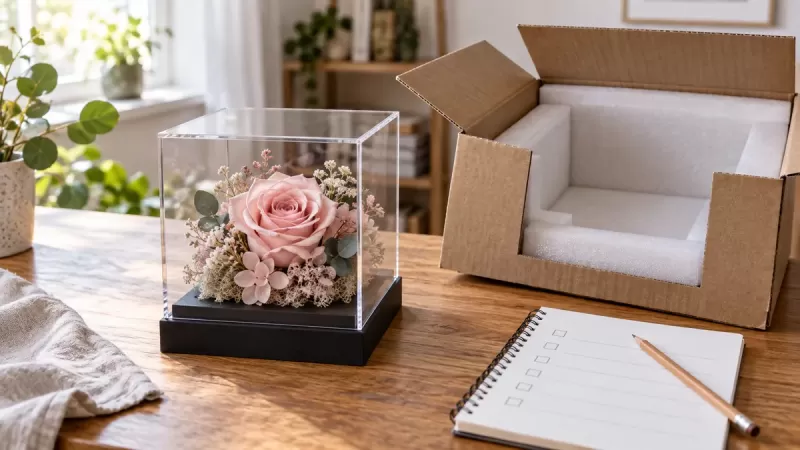
Moving preserved flowers starts with the display, not with wrapping the petals. Inspect the base, frame or enclosure, identify how its weight can be supported, and prepare a clear route and a place to put it down. For a short local move, keep packing pressure away from the flowers and ask the maker for advice if anything is loose or damaged.
This guide concerns a finished keepsake you already own: a rose display, floral frame or similar arrangement. It is not a packing certification, a guarantee against breakage, an international transport guide or instructions for preserving a fresh bouquet. Different constructions need different supports. If you are buying a new gift for delivery instead, use our preserved flower gift delivery checklist.
The feature image is an AI-generated concept illustration. It does not show an exact FLOWEROF product, supplied packaging or a tested transport method.
1. Give the keepsake its own moving plan
Start with three questions: What exactly is moving? Who will carry it? Where will it stand when it arrives? A framed arrangement, a rigid rose box and an exposed bouquet should not automatically share the same packing plan. Write a short identification note for each item, such as “pink rose display from graduation,” so nobody has to open several boxes to find it.
Our suggested planning sheet has five fields: item description, current condition, available packaging, person responsible and destination surface. These are practical editorial prompts, not a formal condition report. They are particularly useful when several relatives are helping and not everyone knows which object is fragile or personally important.
Separate the keepsake from the general “decorations” pile before busy packing begins. Decide whether you can manage its size comfortably, with a clear view of where you are walking. If not, arrange appropriate help rather than improvising while carrying it. A rushed transfer is not the moment to discover that the new shelf is covered with other belongings.
2. Inspect before lifting, and record what you find
The Canadian Conservation Institute's handling guidance recommends examining an object's condition and construction before a move, supporting its weight rather than relying on handles or projecting parts, and planning the route. These are general collection-handling principles, not tests of preserved-flower products. For a flower keepsake, the relevant question is whether you can support the complete display without squeezing the enclosure or touching the arrangement.
Look for an already cracked cover, lifting frame corners, a base that appears separated from its enclosure, or visible loose decorations. Do not shake the item to find out whether it rattles. Take a few clear photographs from outside, including the base and any existing issue. Keep the photographs with your own moving notes; they help you explain a concern to the maker later without relying on memory.
If something has detached, pause. Do not open a sealed frame, pull out a floral insert or apply glue just to meet the moving schedule. Put the item somewhere stable and request construction-specific advice. A decorative cover may not be a load-bearing handle, and a familiar object can have a weakness that was not apparent while it sat undisturbed.
3. Match the support to the object, not the nearest box
UNESCO's Handling of Collections in Storage handbook, particularly its handling and moving chapter, also emphasizes support from beneath, separate cushioning and avoiding stacked objects. Its advice concerns museum collections. The limited application here is to support the rigid parts of a display and prevent contact between separate objects, not to copy specialist mounting treatments or assume household packaging is conservation-grade.
- Intact rigid display: identify the base and any maker-approved handling points. Check that a proposed outer container can accommodate the full object without pressing on the cover.
- Floral frame: distinguish the outer frame from the glazing and the floral composition. A picture-frame technique is not automatically suitable for a three-dimensional arrangement inside it.
- Exposed bouquet: there may be no rigid enclosure to carry the load. Ask the original florist how the stems and arrangement should be supported; do not fill gaps between petals with packing material.
- Damaged or uncertain construction: obtain advice before packing. A larger box does not repair a loose internal mount.
Keep different keepsakes separate rather than nesting one against another. If you retained original packaging, inspect it for damage and check how its inserts originally fitted. Do not assume a crushed carton or missing insert is usable simply because it arrived with the product. Ask whether the packaging is appropriate for reuse in its present condition.
4. Plan the short journey without promising a damage-proof ride
The CCI's explanation of physical forces affecting objects distinguishes risks such as impact, vibration and pressure. That is why a protective display cover and transport packaging serve different purposes. Neither a “fragile” label nor an attractive acrylic case establishes that an arrangement can tolerate a moving van's load or a particular journey.
For your planning conversation with a mover, describe the whole object and its condition, not just “flowers.” Ask how it will be kept separate from heavier belongings, how its outer container will be secured, and who will take responsibility for the final carry into the room. Follow the mover's appropriate load-restraint instructions; do not improvise a position that interferes with a driver, vehicle controls or passenger safety.
Keep the route simple where practical. Our suggested handoff note states which side is the base, where the packed item belongs and who should be contacted before it is opened. It should not advertise expensive contents or include unnecessary personal information. Check that everyone involved understands the same plan rather than assuming that a label explains the construction.
This is a short-move checklist, not a parcel-shipping standard. For a long journey, storage between homes, air travel or a border crossing, seek advice specific to the object, carrier and destination. Do not infer import permission from the word “preserved,” and do not use this article as customs guidance.
5. Choose a landing place before unpacking
Manufacturer Florever's preserved-flower care guidance advises against watering and exposure to high humidity, direct sunlight or extreme dryness. These instructions describe its materials and do not establish the treatment or lifetime of every FLOWEROF arrangement. Use the care instructions for your own item; do not treat a preserved keepsake like a living plant that needs a drink after travelling.
Before bringing the item indoors, choose a clear, stable surface where unpacking can happen without passing tools over the display. Leave enough space for the outer carton and removed inserts. Finish the room's drilling, painting or heavy furniture moves first if possible, so the keepsake does not immediately need to be moved again. This is a practical sequencing suggestion rather than a claim about any specific room's safety.
Unpack in stages and compare the outside condition with your photographs. Avoid pulling on a cover to free the base. If the packaging catches on a component, stop and check the construction rather than forcing it. Keep removed packaging nearby until you have finished inspecting the piece. For ongoing enclosure care, follow the separate acrylic rose box care guide.
6. Use the move to reassess display space, not replace sentiment
The new home may have a narrower shelf, a different room layout or less space for display. Measure the intended surface and compare it with the complete arrangement, including the base and cover. Make a paper footprint first if you are unsure. Check access as well as appearance: you should not have to reach past the flowers to use an everyday switch or storage drawer.
If you are choosing an additional keepsake for the new space, browse the preserved flower collection by actual format and dimensions. For example, the preserved rose swan display is a finished display to assess as a whole object, not a supply of loose stems. Refer to its current photographs and description before deciding whether it fits.
There is no need to discard an existing sentimental arrangement simply because a room has changed. Equally, do not force it into an unsuitable location just to recreate the old arrangement. Choose a workable display plan first. If a product's base, cover or packaging is unclear, ask FLOWEROF about the specific display before moving or ordering it; a general guide cannot identify hidden attachment points.
7. Final checklist before the first lift
- Identify the object and photograph its existing condition.
- Resolve visible damage or uncertain construction with the maker.
- Check the support and packaging without squeezing or shaking the item.
- Clear the carrying route and prepare the destination surface.
- Agree who carries, who opens doors and who receives the item.
- Keep the display separate from heavy belongings and confirm transport arrangements.
- Inspect after arrival before discarding reusable packaging.
Keep the checklist short enough to use. An unanswered question is a reason to pause that step, not to compensate with more wrapping. No checklist can guarantee that a fragile arrangement will arrive unchanged.
Frequently asked questions
Can I move preserved flowers in their display box?
Possibly, but the display box alone is not a verified transport container. Check its condition, how the base is attached and the maker's instructions. Arrange appropriate outer support without pressing on the flowers or cover.
Should I wrap bubble wrap around the petals?
Do not use a generic tight-wrapping method on a floral arrangement. Keep packing pressure away from the flowers and ask the maker where support can safely contact the construction. Exposed bouquets need a different plan from enclosed displays.
Can I lift the arrangement by its acrylic lid?
Do not assume the lid can carry the weight. Identify a stable base or the manufacturer's handling points. If the cover and base appear loose, resolve that issue before lifting.
What if a flower or decoration has come loose?
Stop moving the piece, photograph what is visible and ask the maker for advice. Do not open a sealed frame, push the part back into position or add adhesive without knowing how the display was constructed.
Does a short car journey mean I do not need packing?
No journey length guarantees protection. Consider the object's condition, support, loading and handoffs. The vehicle and load must be handled safely; ask the mover or maker about a suitable arrangement rather than treating the display cover as proof of transport protection.
Should preserved flowers be watered after moving?
Follow the item's preserved-flower care instructions, not living-plant care. Do not add water to a preserved arrangement as a recovery treatment. If its appearance has changed, document the issue and contact the maker.
Leave a comment