-36x36.jpg)



Should you give an academic mentor preserved flowers after graduation? Start with a specific thank-you, not a purchase. Tell the mentor what their guidance helped you do, then check whether they may accept a personal gift and whether a decorative display would suit their space. Graduation does not automatically end every evaluative relationship: a recommendation, thesis decision, job reference, or future supervision may still be pending. If the boundary is unclear, send a note without an item. This guide is for thanking a university or college mentor after a milestone, not for choosing a gift for a classroom teacher or carrying flowers into a commencement venue.
Make the contribution visible in your note
Write about a real conversation, opportunity, or piece of feedback rather than saying only that the mentor was inspiring. The UCSF career office's mentoring guidance recommends telling a mentor how their advice made a tangible difference. For example, you might mention how a suggested research question improved a project or how an introduction helped you explore a career path. Do not disclose someone else's private information, embellish an outcome, or imply that the mentor guaranteed your result. A thoughtful message is useful even when no physical gift is appropriate.
Check whether evaluation has actually ended
Completing a ceremony is not the same as closing every academic decision. Confirm whether a grade has been submitted, a dissertation has been approved, or a reference is still being written. If the person can still evaluate or recommend you, a purchased gift can create an uncomfortable impression of influence. Emory Candler's student-to-faculty gift guidelines encourage notes and caution against gifts that could appear to seek special treatment. Those are one school's guidelines, not a rule for every institution, but they make the timing question worth asking locally.
Ask about the recipient's actual policy
Universities and departments set different acceptance rules. Some discourage material gifts; others distinguish a note from a small item, and public institutions may impose additional restrictions. Read the mentor's own institution or department policy, or ask the relevant office without pressuring the recipient to interpret it for you. A University of Denver faculty committee document explicitly describes student gifts as neither required nor expected and discusses discomfort during grading. Its suggestions are institution-specific and are not a universal legal threshold. When you cannot verify the applicable policy, keep to words of thanks.
Do not treat a gift as payment for a recommendation
A mentor who wrote a reference or opened a door did so in a professional relationship. Thank them after the work has been completed, but do not connect a purchase to the outcome of a reference, admission decision, or job search. If a recommendation is still pending, a card that simply acknowledges their time is safer than sending merchandise. An expensive item is not a better account of their contribution. The recipient must be free to decline without worrying that your relationship depends on accepting it.
Separate the mentor from the graduation ceremony
Our graduation-ceremony flower handoff guide addresses venue entry, carrying and meeting the graduate. A mentor thank-you has a different decision: professional boundaries, the mentor's permission and a suitable later handoff. You do not need to bring a display to the ceremony or ask the mentor to carry it through a crowded venue. A private message after the event may be more comfortable for both people.
Consider whether a display fits their workspace
Before selecting flowers, ask if the mentor likes decorative arrangements and can keep one at home or at work. A shared laboratory, clinic, office or classroom may have rules about personal objects. A preserved-flower display still occupies space, and its container may need a stable shelf. The office-desk placement guide offers physical-placement questions, but it does not override institutional rules. If the mentor travels frequently or does not want another object, send a note and stop there.
Use the collection as a live choice, not a promise
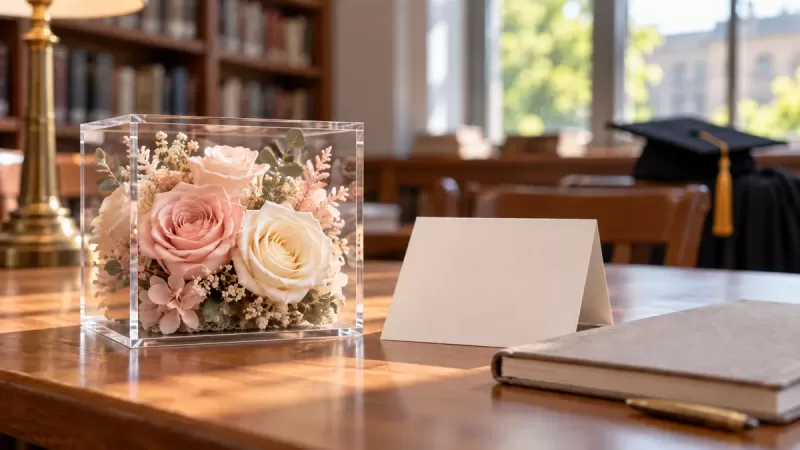
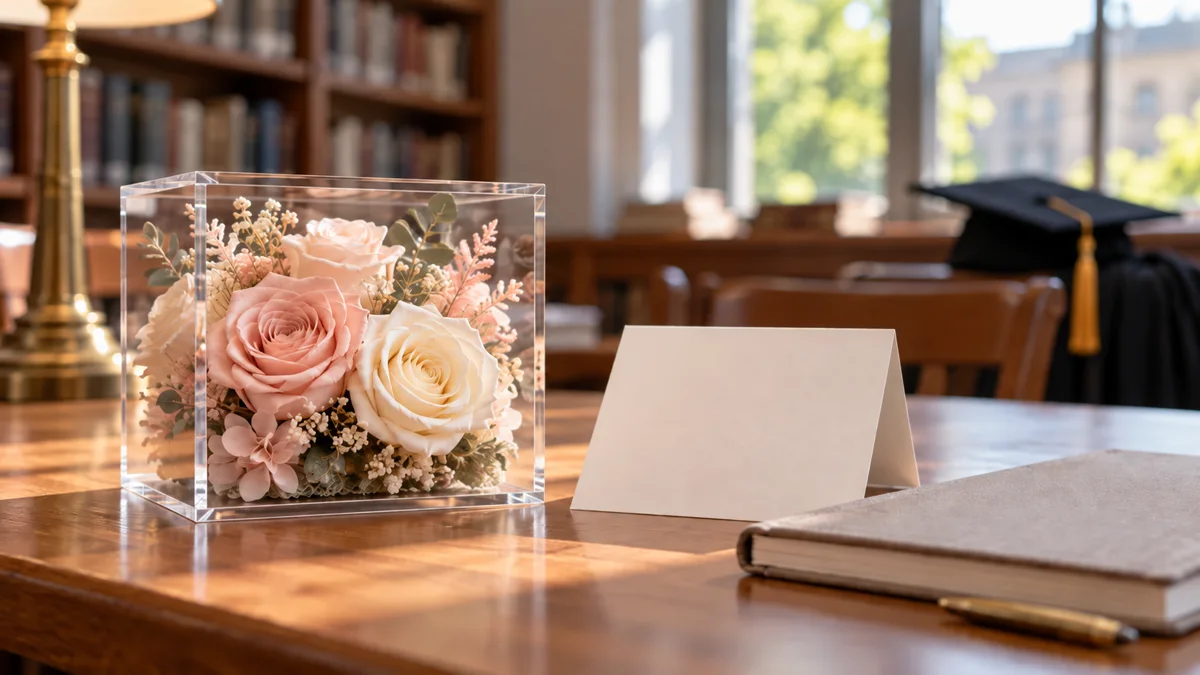
If a gift is welcome and permitted, explore the current FLOWEROF preserved-flower collection and open the exact product page. Check its current dimensions, options, materials, total and product photographs. The image in this article is an illustrative scene, not a catalog listing. Avoid assuming that an ivory-and-blush box, a handwritten card, or personalization is included. For display format, our bouquet-versus-acrylic-box guide helps frame enclosure and shelf-space tradeoffs without choosing for the recipient.
Write a note that can stand alone
A short note can follow three parts: name the guidance, describe what you did with it, and offer sincere thanks. “Your feedback on my final presentation helped me explain the result more clearly” is specific without becoming a request for more help. Do not add a demand for introductions, a future reference or public recognition. A removable card gives the mentor the option to keep the words and decline an item. You can also send an update later, when a genuine outcome shows the lasting value of their advice.
Choose a low-pressure handoff
Do not leave a box in a departmental mailbox, send it to a private address found elsewhere, or surprise a mentor during an examination or meeting. Ask first whether a gift is permitted and whether they would like to receive one. If they accept, agree on a time and place that does not turn their response into a public performance. If shipping is more practical, obtain the address directly with consent. A delayed personal note is better than an uninvited delivery.
Verify live shopping and delivery terms
The FTC's online-shopping guidance recommends checking item descriptions and delivery and return terms before paying. Read FLOWEROF's current delivery information and terms and conditions; use Contact Us for an unclear product detail. This article cannot verify a future stock level, arrival date, return outcome or customization service. Do not promise the mentor a particular object until the live listing and their permission both support it.
Know when a purchase is the wrong answer
Choose a letter instead when policy prohibits gifts, an evaluation is unfinished, the mentor declines, or their taste and space are unknown. Gratitude is not reduced because it does not involve a transaction. The UCSF advice to report a mentor's impact and the university examples about gift boundaries support a message-first approach; they do not imply that every mentor wants flowers. If several mentors helped, write each a truthful individual note rather than giving one a product to signal rank.
Use a five-question decision check
- Can you describe a concrete contribution without exaggeration?
- Are grading, reference and other evaluative decisions complete?
- Does the mentor's institution allow a personal gift, and do they want one?
- Would this exact display fit their taste and space?
- Have you checked the live listing, terms and a consent-based handoff?
If any answer is uncertain, write the note now and postpone the item. This checklist is a way to protect the relationship, not a test the mentor has to pass.
Keep this topic distinct
This page owns the post-graduation academic-mentor thank-you decision: professional policy, remaining evaluation, personal impact and optional display fit. The teacher thank-you guide owns school-classroom acceptance; the ceremony guide owns venue entry and handoff; product pages own live purchasing facts. Those distinctions keep the advice specific rather than multiplying near-identical gift pages.
Frequently asked questions
Is a gift expected when I graduate?
No universal expectation follows from graduation. A specific letter or note can express thanks. Check the mentor's and institution's boundaries before considering any object.
Should I wait until grades or references are final?
Yes, unresolved evaluation is a reason to avoid a purchased gift. Even afterward, confirm the applicable policy and the recipient's willingness to accept it.
Can I send preserved flowers to the mentor's office?
Ask first. Their workplace may restrict displays or deliveries, and the mentor may prefer a note or another handoff location.
Does a group gift solve the policy issue?
Not automatically. The same institution's gift rules and the recipient's preference still apply. A group note may be the simplest option.
What if my mentor declines the flowers?
Respect the answer and thank them with words. Do not insist, raise the price, or ask them to explain a personal or institutional boundary.
Leave a comment