-36x36.jpg)



Consider preserved flowers as a teacher thank-you gift only after checking the school's gift rules and the teacher's preferences. Keep the gesture modest, separate it from requests about grades or special treatment, and choose a personal note instead if a decorative gift is not allowed or wanted.
You do not need to buy something to express appreciation. If a flower keepsake would genuinely suit the teacher, the questions below can help you avoid an awkward refusal or an object with nowhere to go. They are a family planning checklist, not a claim that a particular product is approved by a school.
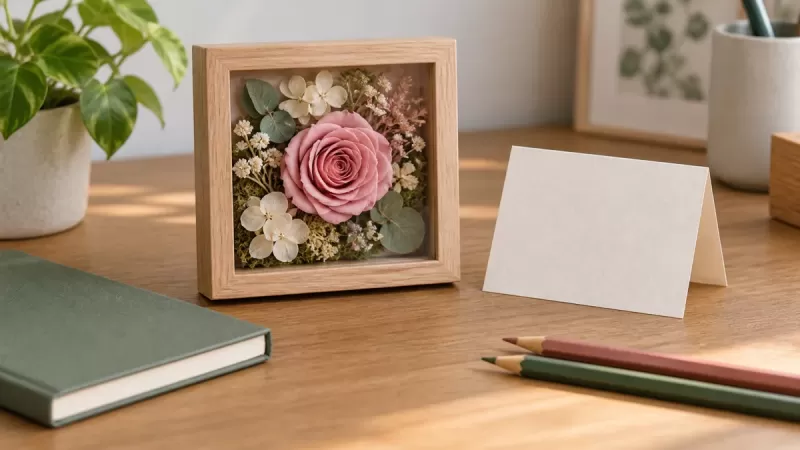
Research reviewed: 13 September 2026. The feature image is an original AI-generated conceptual illustration, not a specific FLOWEROF product photograph. The card, pencils and other props are not represented as included accessories.
Ask about the policy before choosing a gift
Check the school's published guidance or ask the appropriate school office a neutral question before purchasing: “Are individual thank-you gifts allowed, and are there any restrictions we should know about?” Mention the proposed type of item if necessary. Do not ask the teacher to make an exception after you have already personalized it.
As one clearly limited example, Portland Public Schools in Maine discourages routine gifts, says spontaneous student gifts should not be elaborate or unduly expensive, and welcomes letters of appreciation. This is that district's policy, not a rule for all schools or a price limit that can be applied elsewhere.
National PTA independently includes thank-you notes among its teacher-appreciation ideas. Together, these sources support keeping a written thank-you available as a real alternative, rather than treating a purchase as necessary. Neither source endorses FLOWEROF or establishes that preserved flowers are permitted at your school.
Do not infer that the end of term, graduation or a class collection removes the need to check. If the answer is unclear, wait or choose a note. A polite refusal is not an invitation to relabel the gift, route it through another person or deliver it to a private address.
Start with one genuine detail for the thank-you
Ask the student what they want the teacher to know. Perhaps an explanation made a difficult topic understandable, feedback helped them revise a piece of work, or a classroom routine made it easier to ask questions. Let that detail lead the message instead of beginning with a shopping list.
A simple structure is: what the teacher did, what it meant to the student, and a brief thank-you. For example: “Thank you for helping me understand fractions when I was stuck. I felt more confident asking questions after our extra practice.” This is an invented writing example, not a customer testimonial. Change it to reflect a real experience rather than copying a sentiment that did not happen.
Allow the child to use their own vocabulary. Do not include other students' names, private information or a request for future favors. If the note stands on its own, it can still be given even if the flower idea turns out to be unsuitable. No family should feel that a larger purchase makes its appreciation more sincere.
Check whether a lasting display fits the person
If gifts are allowed, the next question is preference. Does this teacher enjoy decorative flowers, or would another form of appreciation be more welcome? Avoid deciding from gender, subject taught or a generic list of flower meanings. If you do not know, a discreet question about preferences is more useful than assuming.
A flower frame may end up at home rather than at school. A classroom desk can have limited space, shared surfaces and its own rules. Do not purchase on the assumption that the teacher must display it publicly. They should be free to choose where an accepted gift belongs.
The guide to planning a flower display on a working desk covers footprint and placement questions. Use those practical checks if a desk is the intended destination; this teacher-gift guide focuses on whether and how to offer the thank-you in the first place.
Shortlist only permitted, suitable products
After permission and preference are clear, browse the preserved flowers collection with a firm spending limit. If the suitable designs exceed that limit, keep the note and stop shopping. Do not divide a purchase between people simply to evade a school's restrictions or describe its value inaccurately.
A framed preserved sunflower design is one catalog option to examine if the teacher likes that flower and the exact gift is appropriate. Check the current dimensions, selected variation, total cost and product information rather than assuming every image shows the same arrangement. This is an option to assess, not a recommendation that it is affordable or acceptable under every school's rules.
Personalization deserves extra care. Avoid permanently adding a class year, school name or phrase before verifying spelling and whether the recipient would welcome it. Do not assume a product supports handwriting reproduction, photo printing or a preview service. Ask about an essential feature before ordering, and keep a non-personalized alternative in mind if the answer is uncertain.
Keep the purchase and handover practical
The FTC's online shopping checklist supports checking the full price and seller policies and keeping relevant purchase records. For this decision, look at the final configuration and destination, not just a starting price. Read the current delivery and return information before committing.
Review FLOWEROF's production and delivery information before planning an end-of-term handover. An occasion date does not guarantee delivery by that date. If timing is uncertain, give the note without announcing a promised arrival that has not been confirmed.
Ask how an accepted gift should be handed over. Do not leave an unexpected parcel at a school reception or seek a teacher's home address through other families. If a proposed item or order detail needs clarification, contact FLOWEROF about the product; the school remains the source for its own acceptance rules.
Keep the exchange brief and low-pressure. Avoid a presentation that asks the teacher to compare gifts, pose for a photograph or respond in front of a class. If they decline, accept that calmly. The thank-you can remain meaningful without persuading someone to keep an unwanted or restricted object.
A short before-you-buy decision card
- Permission: Has the relevant school guidance been checked?
- Preference: Is there a reason to think the teacher wants a decorative flower gift?
- Message: Can the student's own thank-you stand alone?
- Fit: Have the actual product dimensions, variation and total cost been checked?
- Uncertainty: Are personalized wording and any essential feature confirmed?
- Handover: Is there an agreed, practical way to give it without pressure?
- Alternative: Are you comfortable giving only the note if any answer is no?
If the checklist leads to a note rather than a purchase, it has still done its job. The goal is an appropriate expression of gratitude, not getting a particular object into the classroom. Keep product selection secondary to that purpose.
Frequently asked questions
Are preserved flowers always allowed as teacher gifts?
No. Check the relevant school's current rules and the teacher's preferences. Being preserved, framed or purchased by several families does not establish permission.
Is a thank-you note enough?
Yes, it can be a complete expression of appreciation. Write something specific and truthful about the teacher's contribution. A gift is not required to make the message meaningful.
What if the teacher says they cannot accept gifts?
Respect the answer. Do not arrange a different delivery route or ask another student to present the same item. Ask only whether a note would be welcome if that is unclear.
Should I add the teacher's name or a class year?
Only after checking the recipient's preference, the school's rules and the product's actual personalization options. Check every character before ordering; do not presume changes or previews are included.
Can the gift be displayed in the classroom?
That is for the teacher and school to decide. Consider the available space and applicable display rules, but do not make public classroom display a condition of giving the gift.
Leave a comment