-36x36.jpg)



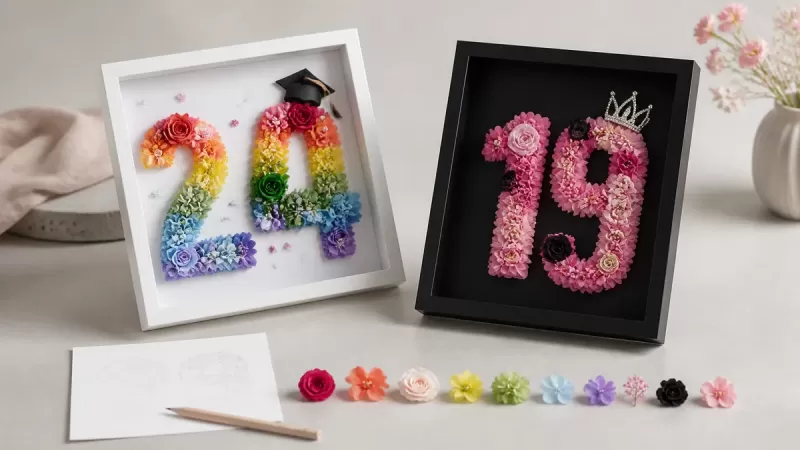
Short answer: use the year that the recipient wants the gift to commemorate, then confirm it before ordering. For some graduates, that is the commencement year; for others, it is the degree-conferral year or the year printed on a personal milestone. They are not always the same. A personalized floral number frame works best when the number has a clear meaning to the recipient—not when a sender guesses from a ceremony photo.
This guide is for choosing the year on a graduation flower gift with a number or letter display. It does not determine anyone’s academic status. Colleges set their own conferral and commencement rules, so a public ceremony date is not a universal substitute for the graduate’s preference or their institution’s record. MIT, for example, describes multiple degree-conferral dates within one academic year, while Stanford distinguishes degree conferral from commencement participation. Those examples are a useful reminder to ask before personalizing a keepsake.
Start by deciding what the number is meant to celebrate
“Graduation year” can mean more than one thing. Before selecting a floral frame, name the occasion in one plain sentence: “This is for the ceremony we attended,” “This marks the degree being awarded,” or “This is the year you want to remember.” That sentence becomes the approval check for every design choice that follows.
- Ceremony memory: choose the calendar year of the celebration or commencement event if that is the story the recipient values.
- Degree milestone: choose the conferral year only after the recipient has confirmed it; institutional schedules can differ from ceremony timing.
- Personal milestone: choose the year attached to a transfer, return to study, professional qualification, or family celebration when the gift is about that event rather than an official record.
If you are choosing a surprise gift, a simple indirect question is safer than an assumption: “What year would you want on a keepsake from this graduation?” You do not need to request a transcript or document. The recipient’s own answer is the appropriate source for a personal gift.
Why ceremony year and degree-conferral year can differ
University calendars are not standardized. MIT’s Registrar graduation information explains that its degrees are conferred three times each year, while students in those degree periods may take part in a spring commencement in the same academic year. Stanford’s degree-conferral policy likewise separates the awarding of degrees from eligibility to participate in commencement.
These policies do not tell you which year to use for every school. They show why a sender should not treat one public event as a universal rule. When the gift needs to be a surprise, choose a design that can be approved before production, or give a card describing the intended number and let the recipient confirm it.
Match the milestone to the format of the gift
A floral number frame is especially direct when the milestone is a four-digit year. FLOWEROF’s personalized preserved-flower number frame currently offers a number-or-letter selection with a limit of no more than two characters. That means a complete four-digit year should be planned as a pair of characters rather than assumed to fit in one field.
For a year such as 2026, decide whether the finished display will use two paired pieces, a number plus a short message, or another approved arrangement. Do not assume that a photo reference, a graduation-cap decoration, a requested color, or a message field creates an automatic layout approval. Use the available form fields to communicate the idea, then ask the shop through contact if the arrangement needs a confirmation before ordering.
Use a two-part plan for a four-digit year
Writing the number down as two pairs prevents a common personalization mistake. For example, record “20 + 26,” not simply “2026.” This makes the intended structure legible to everyone involved in the gift.
| What to write down | Why it helps |
|---|---|
| Milestone: commencement, conferral, or personal celebration | Keeps the year tied to a meaning instead of an assumption. |
| Number plan: first pair + second pair | Matches a two-character personalization limit more clearly. |
| Color preference and optional decoration | Separates visual preferences from the number itself. |
| Message or card wording | Lets the recipient understand what the date commemorates. |
For broader personalization options, start with the custom preserved flowers collection. The collection page and product form are the right places to review the current choices; this article is not a guarantee that every combination is available.
Check the year with the graduate before production
A short approval note can make a surprise feel considered rather than administrative. Try: “I’m choosing a flower keepsake for your graduation. Should the number celebrate 2026, or is there another year you would prefer?” This leaves room for a December graduate, a delayed ceremony, a joint celebration, or a milestone that matters more than the formal schedule.
For a group gift, appoint one person to collect the answer and preserve the exact wording. This avoids different relatives or classmates submitting conflicting dates. If the group is still deciding, a non-personalized preserved-flower gift may be less risky than rushing a permanent number choice.
Keep the message specific without overstating what it proves
A year on a gift is a personal tribute, not an academic credential. Pair it with a message that states the occasion in the sender’s own words: “Celebrating your 2026 commencement,” “For the class of 2026,” or “In honor of the year you chose.” Avoid language that claims a degree was conferred unless the graduate has explicitly asked for that wording.
This distinction is useful for all personalized pieces. The existing number-frame customization guide explains how to organize the design inputs; this guide adds the earlier decision step of choosing what a graduation year represents.
Plan delivery around the event, not a promise of an arrival date
Once the year and design are approved, review the current delivery information before setting an event date. Production and transit estimates can change, and a graduation date does not make an arrival guaranteed. If timing is tight, send a card describing the intended keepsake and place the personalized order only after the number is confirmed.
A final graduation-year checklist
- Ask what the year should commemorate.
- Confirm the exact four digits with the recipient or a trusted coordinator.
- Write the number as two planned character pairs where needed.
- Separate number, color, decoration and message instructions.
- Check current product options and contact the shop when a layout needs clarification.
- Review delivery information before tying the gift to a fixed event date.
Frequently asked questions
Should I use the graduation ceremony year or the degree-conferral year?
Use the year the recipient wants the gift to commemorate. Those dates can differ under an institution’s rules, so ask rather than infer it from a ceremony.
Can a four-digit graduation year fit on a two-character flower frame?
Plan it as two character pairs, such as 20 and 26, when using a product with a two-character selection limit. Confirm the intended arrangement before ordering.
Is a graduation-cap decoration proof that the gift is for a completed degree?
No. A decoration is a visual preference. It does not establish academic status or replace the recipient’s choice of milestone wording.
What if I want the gift to be a surprise?
Ask an indirect question about the year they would like to remember, or choose a non-personalized gift first. Guessing a permanent date can create an avoidable mistake.
Can I request a message with the year?
Use the product’s current message field where available and keep the wording personal and specific. Contact FLOWEROF if you need clarification about how a requested layout can be handled.
Feature image note: this article uses a FLOWEROF-owned conceptual number-frame image. The sample numbers and graduation-cap detail illustrate a personalization idea; they do not represent a specific graduate, school, year, or guaranteed product configuration.
Leave a comment