-36x36.jpg)



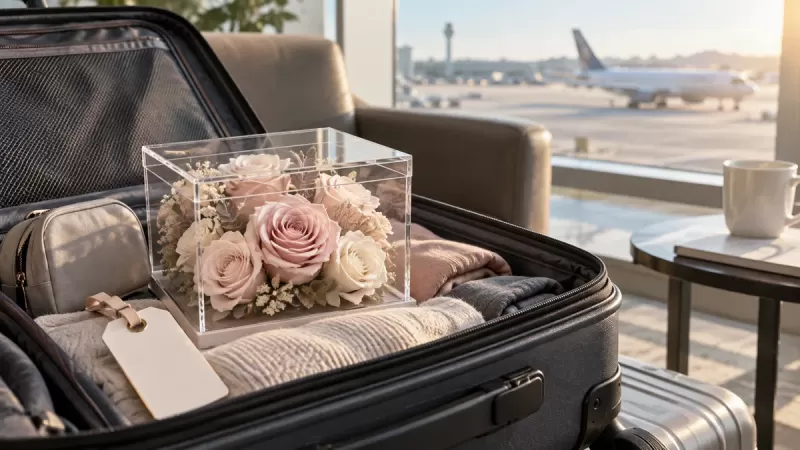
Can you take a preserved-flower gift on a plane? There is no one answer for every route or arrangement. First check what the exact gift contains and how large its protective box is. Then check security screening, your airline's cabin-bag rules, and any plant-product rules at your destination or connecting country. A gift that passes a checkpoint may still be too large for your bag or inadmissible at a border. This guide is a planning checklist, not an airport approval or customs ruling.
Answer three different questions before packing
Airport screening, airline baggage acceptance and border entry are separate decisions. The United States Transportation Security Administration (TSA) lists fresh flowers as permitted through its checkpoint without water, but its What Can I Bring? list also says a listed item may require further screening and that an officer makes the final decision. That entry is about fresh flowers; it is not a blanket certification of every treated, framed or boxed preserved-flower product. Your airline sets the bag size and fragile-item handling rules. A destination government may separately regulate plant material. Checking only one of these three sources is not enough.
Identify the exact object, not just the word “flowers”
Is the gift a small framed flower, a loose bouquet, an acrylic-box arrangement, or a display with a liquid or electronic accessory? These are physically different objects. Open the current product listing and note its outside dimensions, materials, case, option and any removable parts. Do not infer that a lifestyle photograph represents the package size. FLOWEROF's preserved-flower collection includes both framed and three-dimensional formats. For example, the framed preserved-sunflower listing states 20 × 15 cm; this article does not claim that its shipping package has those dimensions or that it is approved for any flight. Recheck the live item before purchase.
Measure the gift and protective packaging together
A 20 cm frame may need a larger protective sleeve or box, while a three-dimensional acrylic display takes space in every direction. Measure the final packed object, not only the decorative piece. Compare it with the airline's current carry-on and personal-item limits for every leg of the itinerary. Delta's carry-on guidance is an example of an airline publishing its own policy; it does not set a universal size for other carriers. If the object cannot fit within an allowed bag or be stowed safely, do not assume an exception will be made at the gate.
Ask the airline about a fragile or unusual display
A rigid acrylic case might be vulnerable to pressure or impact even if the flowers are enclosed. Delta's fragile-item guidance distinguishes cabin and checked transport and notes that conditions can apply. Contact the actual carrier if the object is bulky, expensive, fragile or difficult to pack. Ask about stowage and whether any extra wrapping must be opened for inspection. The airline's answer is route- and ticket-specific; a blog cannot promise protection against damage or a waiver of baggage rules.
Check border rules when the journey crosses a border
Security permission to board does not establish permission to import plant material. The U.S. Department of Agriculture's international traveler guidance says travelers entering the United States must declare agricultural products, and requirements depend on the plant material, origin and intended use. An inspector decides admissibility. A preserved display is not automatically treated as a fresh bouquet or an artificial flower. For travel into another country, use that destination's current official plant-health and customs guidance. If you cannot identify the plant or treatment well enough to check the rule, ask the relevant authority before carrying it.
Keep a factual item record without making a certificate
Save the exact product name, seller listing and purchase record where you can retrieve them if asked. The USDA suggests keeping receipts and original packaging as evidence of origin for U.S. entry, but a receipt does not replace a required permit or inspector decision. Do not print a homemade “travel approved” label, assume a sealed acrylic box eliminates declaration duties, or describe dyed real flowers as plastic. If the destination asks for species, treatment or origin information that the listing does not provide, use FLOWEROF Contact Us to ask what factual details are available before making travel plans.
Protect the display without hiding it
Use a stable, padded container that prevents the frame or acrylic case from moving inside the bag. Keep the arrangement upright when practicable and avoid putting heavy items against the clear cover. Do not place water, sprays or loose gels with the gift; preserved flowers are intended for dry indoor display, as the care guide explains. Pack so a screening officer can inspect the object without tearing into a tightly glued presentation. This is common-sense damage reduction, not a guarantee that the case, petals or luggage will arrive intact.
Decide whether to carry, check or send separately
Carrying a small protected object where you can monitor it may be preferable to checking it, but the choice depends on airline rules, available space and any border restrictions. A large boxed bouquet may simply be impractical as cabin baggage. For a domestic recipient, consider sending the gift directly instead and use the shipping guide for address, receiving and packaging questions; that guide owns parcel logistics, while this page owns passenger travel. Read the current delivery information before deciding whether separate shipment fits the occasion. Do not assume shipment bypasses destination import rules.
Do not build the gift around an arrival promise
Flights change, baggage can be gate-checked and border inspection takes time. If the recipient needs the gift at an event, plan for a late or rejected handoff. A small note or photograph can communicate the intention without claiming the physical gift is already through customs. If an exact date is essential, ask the airline and destination authority directly and make a backup plan. Do not make a purchase based on an unverified “carry-on safe” search snippet.
Use the product page as the final shopping source
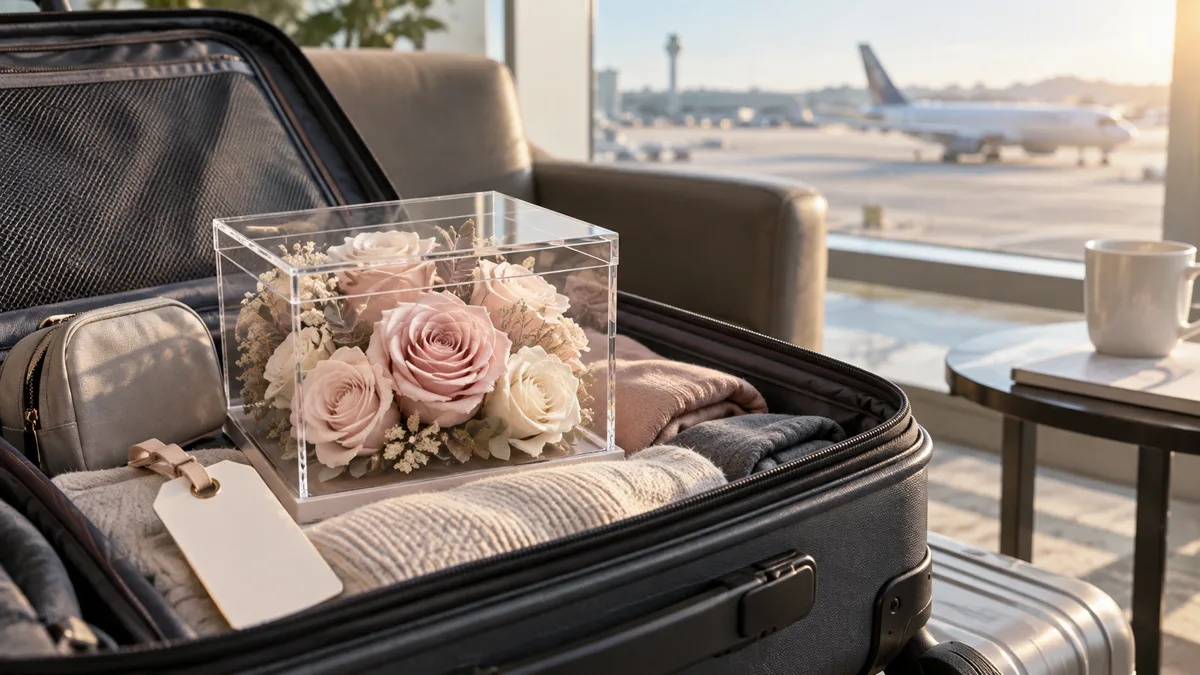
If a travel-friendly format seems possible, open the exact FLOWEROF listing and confirm its current options, dimensions, total cost and terms. The bouquet-versus-acrylic-box guide can help compare display formats, but the live product page owns what is offered. Do not select a color from this article's illustrative image. A purchase should be based on a verified item you would still want if you had to hand it to the recipient after the trip rather than during it.
A five-minute departure checklist
- Identify the exact item, real botanical material and any non-flower parts.
- Measure the packed width, depth and height against every airline's current limits.
- Ask the carrier about fragile-item handling if the case or frame is unusual.
- For international travel, check the destination and transit countries' official plant-product rules and declaration requirements.
- Keep factual purchase details accessible; pack for inspection and have a non-object backup greeting.
If one of these answers is missing, pause rather than assuming that “flowers allowed” settles the entire journey.
Frequently asked questions
Does the TSA flower listing approve preserved flowers?
No blanket approval follows from that entry. It specifically discusses fresh flowers without water, and checkpoint officers retain final discretion. Ask TSA about the exact item if its composition or case is unusual.
Is an acrylic flower box automatically a carry-on?
No. Compare the outside dimensions of the packed item with your carrier's allowance and ask how a fragile case may be handled. An acrylic case is not a substitute for airline acceptance.
Do I have to declare preserved flowers when entering the United States?
USDA APHIS says travelers must declare agricultural products entering the United States. Check the current official guidance for your exact product and route; the inspector decides admissibility.
Would shipping the gift avoid plant import rules?
Not necessarily. Shipment has its own carrier, customs and destination requirements. Check those separately and do not treat a domestic delivery guide as international import clearance.
What if I cannot confirm the flower species or treatment?
Ask the seller for factual product details and consult the destination authority before traveling. If a reliable answer is unavailable, choose another gift or deliver it locally instead of making an approval claim.
Choose the trip plan before the flower display
A preserved-flower gift may be meaningful at a destination, but the right order is item facts, airline fit, border rules, then purchase and packing. If the conditions do not line up, the gift can wait. The reader should leave with a decision they can verify, not an unsupported promise that every flower box can fly.
Leave a comment